
Every seller’s dream is to have as much traffic that generates buys, as possible. However, achieving this is not as easy as it seems. A lot of people spent enormous amounts of money on advertising, all in order to bring more customers to their website. Why is it then, that the average rate of e-commerce conversion is somewhere between 1-5%? What are store owners doing wrong?
read more
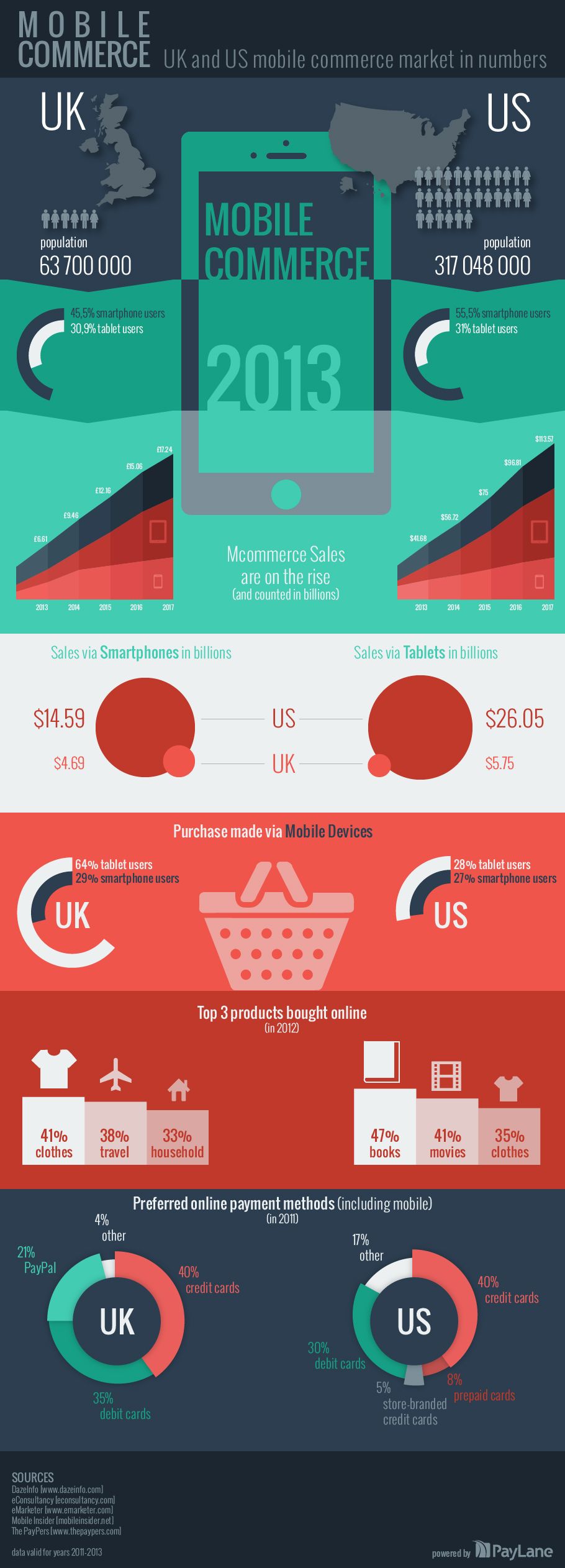
Considering focusing more on Mcommerce? Here’s a great infographic to see how the mobile commerce market is growing in the UK and US.
Embed this infographic on your website:
read more
 One of the most popular payment methods in some countries (such as German-speaking regions) is direct debit. Let’s compare this payment method to credit card payments…
read more
 Scam and scammers are something that we need to fight with almost each day. Unfortunately it’s one of the worst plagues of our industry. How many times did you receive an e-mail with a request to change the password in some kind of e-wallet service (such as PayPal)? How many times were you asked to do something in your bank account? To have it done you just needed to click on some link in the email and put your login and password in a login form. Simple. But fake.
Those websites look similar to the original ones. But they are not. Once you put your login and password – these credentials will be stored in scammer’s database.
read more
 Chargebacks and retrieval requests are inevitable part of doing online business. Many businesses need to handle chargebacks and retrievals on a daily basis, while for some others a chargeback or retrieval request is a rare thing. Yet in both cases it is good to know what the difference between the chargeback and retrieval request is. This knowledge will enable you to react quickly and take the appropriate measures to resolve these situations in a timely and efficient manner when they occur.
A retrieval request, also known at some banks as “soft” chargeback, takes place when the credit card issuer contacts the merchant to obtain information about a transaction charged to one of its cardholders. The reasons for retrievals can be various: it may be a result of a customer question or dispute, inaccurate or incomplete transaction information, a processing error or an indication of potential fraud. The bank will request a legible copy of the transaction authorization proof.
read more
 Online shopping and its development is a hot topic- whether it’s about safety, business types or pros and cons in comparison to a ‘regular shop’. In the meantime, online payments, a matter equally important, is put on a back burner.
Payment processors are not in charge only of efficient mediacy and safety of our transfers- the choice of such providers should depend also on the type, size and outlook of your business. It might be worth then to get to know each provider to make sure your decision is a good one.
read more
 Have you ever been asked for an ID scan or any other identity proof when making a payment with a credit card online? If not, then this question may seem quite strange to you. After all, paying with credit cards is meant to be quick and easy.
It turns out that many people who experience such additional verification are pretty surprised and suspicious. It’s not what they’re used to, they already provided the CVV number, so why are they supposed to send somebody (even if its a bank) their account statements, passports, driving licences or anything like that.
read more
 CVV codes described in the previous part aren’t the only way to make your transactions secure. There are forms of security, which are based on the payer’s localization. However, you may also come across simpler solutions, where only entered data is verified.
An example of that could be AVS – its mechanism compares your address info given in the shopping order with details of the card holder. Depending on the degree and type of eventual errors, AVS returns an appropriate error code, which are the base of estimating the probability of a fraud. Contrary to appearances, it is not inconvenient to clients – the system can tell the difference between a real scam and a situation when a buyer made a spelling mistake.
read more
What factors make for a successful business? Is it the product? Of course. Customer support? Sure. Competitive prices? Naturally. But what if a potential customer doesn’t get to experience the quality of your services, because they have been put off by your company’s site, which looks as if it was “designed” by a 10-year-old in 1996?
An attractive, eye-catching website has become the norm in today’s e-commerce world. Is it still possible to run a business without a site or one that is absolutely atrocious? Have you ever been discouraged from shopping online or using someone’s services based on their www?
A website is a make-or-break of a company. So, to make sure you don’t fall into the latter category, here are 4 main tips you might want to follow…
read more
 If you are an online payments newbie, no doubt you’re getting lost in all the new expressions, phrases and definitions. That’s why we come to your rescue with this 3-part introduction to payments safety. Today, we set off with CVV2.
read more